












Introduction
Risk intelligence case files are most useful in aggregate - a single disruption is a news story, but a quarter’s worth of them is a pattern.
This review walks through what actually disrupted global supply chains in Q2 and Q3 2026, case by case, with the specific data behind each event and what it means for how shippers should be monitoring risk heading into Q4.
Case File One: The Strait of Hormuz Crisis
What happened
Military escalation around the Strait of Hormuz began February 28, 2026, and remained a live, unresolved disruption through Q3.
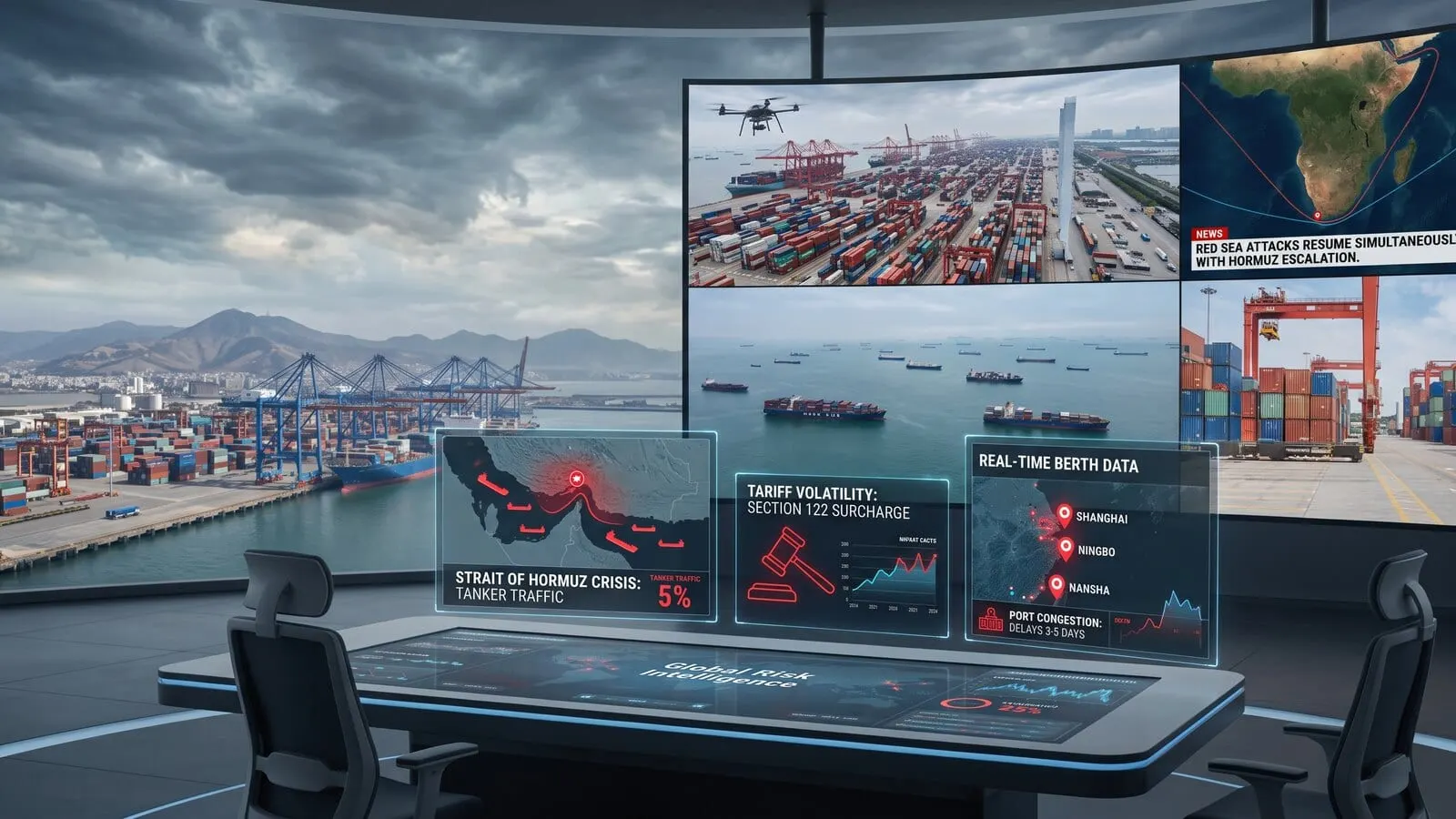
Tanker traffic through the strait - normally around 178 vessels a day - dropped by an estimated 95%, with more than 1,500 commercial vessels and over 20,000 mariners reported stranded at points during the crisis.
War-risk insurance premiums spiked sharply as insurers repriced or withdrew coverage for Gulf transits.
Why it mattered beyond energy markets
While Hormuz is best known as an oil chokepoint, the disruption’s supply chain impact extended well past energy cargo.
Container and general cargo carriers rerouting around the Cape of Good Hope absorbed weeks of added transit time, and the Red Sea corridor reopened to renewed attacks in the same window, compounding the disruption across two major corridors simultaneously.
The risk intelligence lesson
The US Navy-led Joint Maritime Information Center upgraded its Hormuz risk advisory from “substantial” to “severe” before the situation deteriorated further - a signal that was public and actionable before transits actually stopped.
Shippers monitoring geopolitical advisory data had a window to reroute or renegotiate terms that shippers relying only on carrier notifications did not.
Case File Two: Tariff Volatility Becomes a Standing Cost
What happened
A 10% import surcharge under Section 122 of the Trade Act took effect February 24, 2026.
Litigation challenging its legality proceeded through the quarter - a Court of International Trade ruling in May 2026 was stayed by June, keeping the surcharge in effect even as its legal status remained contested.
Why it mattered
Industry surveys through the quarter found 72% of trade professionals identifying tariff volatility as the most impactful regulatory change they were managing, and more than 75% believed the current approach would persist for years rather than resolve as a short-term negotiating position.
That shift - from tariffs as an occasional shock to tariffs as a standing planning assumption - changed how procurement and sourcing teams budgeted for the rest of the year.
The risk intelligence lesson
Unlike a sudden chokepoint crisis, tariff risk unfolded slowly enough that companies tracking policy and litigation developments had months of lead time to adjust sourcing and pricing strategy.
The cost fell hardest on teams treating each tariff development as a one-off surprise rather than part of a trend they had already been warned about.
Case File Three: Persistent Port Congestion in Asia
What happened
Major Chinese gateways - Nansha, Ningbo, Shanghai, and Shekou among them - operated through the quarter with high yard occupancy and multi-day vessel delays, keeping global container schedule reliability plateaued in the 62-67% range rather than recovering to pre-disruption norms.
Why it mattered
Unlike the Hormuz crisis, this was not a single dramatic event - it was a grinding, structural condition that quietly eroded on-time performance across a huge share of global container volume.
Peak-season rate increases of 10-20% on transpacific lanes added cost volatility on top of the timing risk.
The risk intelligence lesson
Structural congestion is exactly the kind of risk that is easy to normalize and stop actively monitoring, precisely because it does not arrive as breaking news.
Shippers with real-time berth and yard-occupancy visibility into their specific gateway ports adjusted booking and buffer strategies through the quarter; shippers relying on carrier ETAs alone absorbed the delays as they happened, case by case.
What the Quarter Adds Up To
| Case File | Duration | Addressable Through |
|---|---|---|
| Strait of Hormuz crisis | Feb 2026 - ongoing through Q3 | Geopolitical advisory monitoring, rerouting plans |
| Tariff volatility (Section 122) | Feb 2026 - ongoing through Q3 | Policy/litigation tracking, scenario planning |
| Asian port congestion | Persistent through Q2-Q3 | Real-time berth/yard visibility, buffer planning |
None of these three case files were secret.
Each had public, trackable signals - a risk advisory upgrade, a court ruling calendar, published port congestion data - well before the disruption hit the shipments that were not watching for them.
For the framework behind why this pattern repeats every quarter, see The Cost of a Missed Alert: Real-World Scenarios Where Risk Intelligence Saved (or Could Have Saved) a Shipment, and for the full data behind this quarter’s numbers, see Quantifying Supply Chain Risk: A 2026 Data Report on Disruption Costs Worldwide.
Get Your Own Quarterly Risk Review
Industry-wide case files show the pattern; your own shipment data shows your specific exposure.
Request a quarterly risk review and we will build the same kind of case-file analysis using your actual Q2-Q3 shipments and lanes.
Conclusion
Q2 and Q3 2026 delivered three overlapping disruptions - a geopolitical chokepoint crisis, sustained tariff volatility, and persistent port congestion - each with public signals that preceded the worst of their impact.
The shippers who came through the quarter with the least damage were not the ones who avoided disruption; they were the ones watching for the signals early enough to act on them.
Related reading: The Cost of a Missed Alert · Quantifying Supply Chain Risk: A 2026 Data Report · Strait of Hormuz crisis coverage
Frequently asked questions
What was the biggest supply chain disruption of Q2-Q3 2026?
The Strait of Hormuz crisis, which began February 28, 2026, and remained a live disruption through Q3, cutting tanker traffic through the strait by roughly 95% and forcing major carriers to reroute around the Cape of Good Hope.
Did the Section 122 tariff surcharge remain in effect through the quarter?
Yes. Despite legal challenges - including a Court of International Trade ruling in May 2026 that was stayed by June - the 10% surcharge remained in effect through Q3 2026.
How bad was port congestion in Asia during Q2-Q3 2026?
Major gateways including Nansha, Ningbo, Shanghai, and Shekou operated with high yard occupancy and multi-day delays through the quarter, keeping global schedule reliability in the 62-67% range.
Were these disruptions predictable in advance?
Each had public, trackable signals ahead of its worst impact - a risk advisory upgrade for Hormuz, a published litigation calendar for the tariff surcharge, and ongoing congestion data for Asian ports - meaning risk intelligence monitoring provided real lead time in all three cases.
What should shippers watch for heading into Q4 2026?
The same three risk categories remain live: whether the Strait of Hormuz situation resolves or escalates further, how tariff litigation concludes, and whether Asian port congestion eases with any seasonal demand shift.
References
- UN Trade and Development (UNCTAD), Strait of Hormuz Disruptions: Implications for Global Trade and Development.
- Allianz Commercial, Safety and Shipping Review 2026.
- Thomson Reuters, The 2026 Supply Chain Challenge: Global Trade Disruption.
- Maritime Gateway, Container Shipping Forecast 2026: Rates, Routes and Risks.