












Introduction: the million-dollar blind spot
In 2026, a single supplier failure halfway across the globe can halt your entire operation within 72 hours. Port closures, blank sailings, customs delays, cold chain breaks, geopolitical shocks: these are no longer edge cases. They are the operating environment.
The painful truth? Almost every supply chain crisis had early warning signals buried in the data.
The problem is not that companies do not understand risk management. The problem is they are managing it blind.
This article explains why the gap between risk management and risk intelligence is the most expensive gap in modern logistics, and how closing it transforms your supply chain from a cost centre into a competitive weapon.
01 — Risk Management vs. Risk Intelligence
Most supply chain teams practise risk management. Few have achieved risk intelligence.
The difference is not semantic. It is structural, operational, and financial.
What risk management does
Risk management is the systematic identification, assessment, and mitigation of threats across your supply network. It involves supplier audits, contingency planning, insurance policies, and compliance frameworks.
It is essential, and it is not enough.
Risk management operates on a reactive-to-monitoring timeline. It asks: “What could go wrong, and what is our plan if it does?”
What risk intelligence adds
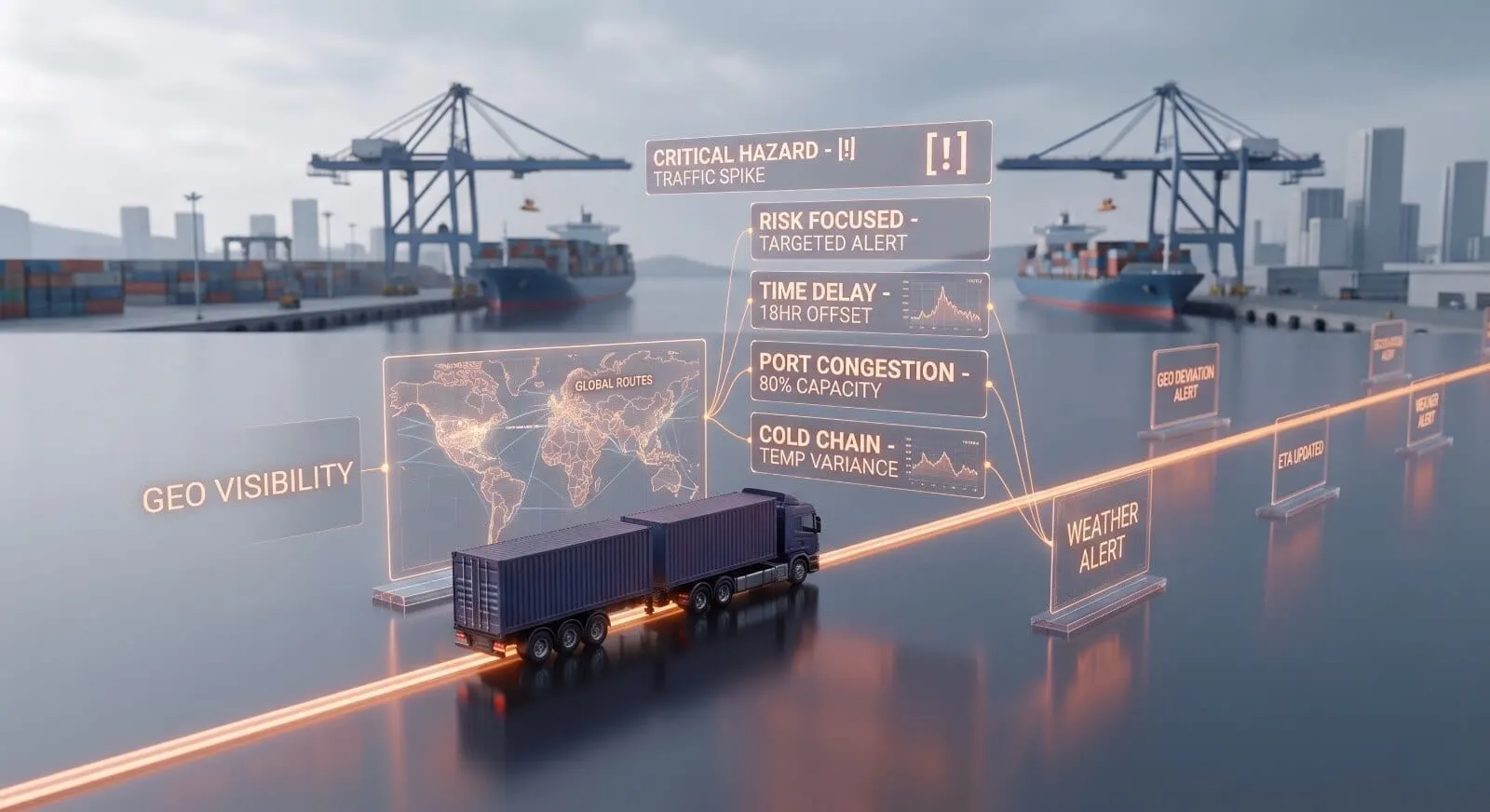
Risk intelligence is the continuous, real-time correlation of multi-source data streams: vessel AIS positions, port congestion data, weather patterns, carrier performance history, geopolitical signals, and operational milestones.
It detects emerging risks before they materialise.
Risk intelligence operates on a predictive-to-preventive timeline. It asks: “What is about to go wrong, and how much time do we have to act?”
| Dimension | Risk Management | Risk Intelligence |
|---|---|---|
| Timeframe | Past & present | Future — before the incident |
| Data sources | Internal, periodic audits | Real-time multi-source correlation |
| Alert mechanism | Manual reporting | Automated, contextualised alerts |
| Action window | After the event | Before the event — while action is still possible |
| Financial impact | Limits damage | Prevents damage entirely |
Companies that proactively manage supply chain risk spend 50% less to manage supplier disruptions than companies that are not proactive. — Deloitte, Risk Management in the Supply Chain
02 — Why Traditional Risk Management Fails in 2026
The supply chain landscape of 2026 is structurally different from even three years ago. Three forces have rendered passive risk management insufficient.
Force 1: complexity explosion
Global supply chains now involve an average of 12 to 15 intermediaries per shipment: carriers, forwarders, customs brokers, port authorities, warehousing partners, and last-mile operators.
Each intermediary generates data in silos. No single human eye can correlate signals across all of them in real time.
Force 2: velocity of disruption
The Strait of Hormuz closure in 2026 demonstrated that geopolitical shocks can reshape logistics corridors overnight. The cascade of cost impacts — freight rate spikes, insurance surcharges, rerouting delays — unfolded in hours, not weeks.
Force 3: the cost of invisibility
Demurrage and detention fees alone can amount to $75-300 per container per day depending on port and carrier (Freightos, “What is Demurrage”, 2024).
These charges appear on invoices weeks after the incident that caused them, long after the action window closed.
Companies that rely on traditional risk management are structurally unable to prevent the costs they can already predict.
03 — The Five Layers of Supply Chain Risk Intelligence
A mature risk intelligence system operates across five interconnected layers. Each layer adds compounding value, and missing any one of them creates a blind spot that competitors will exploit.
Real-time position intelligence
Contextual anomaly detection
Predictive risk scoring
Financial impact quantification
Action recommendation engine
How FreshTrack delivers all five layers: see Proactive Detection of Logistics Anomalies: What Your TMS Will Never See on the FreshTrack blog, a deep dive into how FreshTrack’s architecture differs from classic TMS platforms.
04 — The Real Cost of Reactive Risk Management
Let us trace the financial cascade of a single undetected logistics incident, the kind your TMS will never warn you about.
Scenario: a container stuck at a transit port
| Stage | Event | Time | Cost impact |
|---|---|---|---|
| 1 | Container blocked at transit port | H+0 | Zero — incident just started |
| 2 | Carrier updates status in system | H+18 | Zero — still within reporting window |
| 3 | Operator checks TMS during morning review | H+26 | Demurrage free time ticking |
| 4 | Rerouting window closes | H+12 | Rerouting no longer possible |
| 5 | SLA penalties triggered | H+30+ | Contractual penalties activated |
| 6 | Customer informed after the fact | H+36+ | Trust relationship damaged |
The total cost of a single late-detected incident can reach tens of thousands in direct fees, plus immeasurable damage to customer relationships and operational credibility.
Now contrast this with the same incident detected at H+2 by a risk intelligence platform: before demurrage starts ticking, before the rerouting window closes, before the customer has to find out from their own tracking rather than from you.
05 — From Visibility to Intelligence
FreshTrack does not replace your TMS. It grafts onto your existing system the one layer your TMS structurally cannot provide: the ability to see what is about to happen before it occurs.
What makes this different from “just another dashboard”
| Capability | Classic TMS | Risk Intelligence (FreshTrack) |
|---|---|---|
| Position tracking | Partial, carrier-dependent | Complete, multi-source |
| Anomaly detection | Reactive — confirmed after the fact | Proactive — before the incident |
| Demurrage alerts | None | D-3 anticipation |
| Route risk analysis | None | AI-powered, historical data |
| Cold chain monitoring | None | Real-time temperature alerts |
| Financial impact | Not quantified | Quantified per shipment |
| Carrier performance | Limited, siloed | Consolidated, benchmarked |
The data is the same in both configurations. The only variable is the ability to anticipate.
06 — Risk Intelligence in Practice
Use case 1: the blank sailing that never reached your TMS
Shipping lines occasionally cancel sailings without advance notice. A risk intelligence engine detects the anomaly by cross-referencing vessel AIS data against published schedules, alerting you before the blank sailing is officially confirmed and giving you time to rebook on an alternative vessel.
Use case 2: the cold chain drift nobody reported
A reefer container’s temperature rises 2°C above the acceptable range during transit. The carrier’s system reports “on schedule.” Risk intelligence detects the deviation through IoT sensor data and alerts the quality team, preventing a total product loss that would have appeared only upon arrival.
Use case 3: the port congestion cascade
Congestion at a major transhipment hub builds over 72 hours. Your TMS shows “on time” because the carrier has not updated. Risk intelligence correlates port traffic data with your shipment’s expected transit time, flagging a demurrage risk 5 days before it materialises.
07 — Building Your Risk Intelligence Roadmap
Step 1: audit your current detection gap
Map every incident type your team currently discovers on invoices rather than in real time. Demurrage, detention, cold chain losses, SLA penalties, emergency rerouting costs: quantify each category over the past 12 months.
Step 2: identify your highest-cost blind spots
Not all risks are equal. Prioritise by financial impact: which undetected incidents cost you the most per occurrence?
Step 3: evaluate your detection architecture
Ask whether your current toolset detects anomalies in real time or waits for carrier updates. Ask whether it correlates multi-source data or operates in silos. Ask whether it quantifies financial impact or simply shows status.
Step 4: deploy risk intelligence as a strategic layer
FreshTrack operates as a complement to your TMS, not a replacement. It adds the predictive intelligence layer that turns your existing data into actionable, financially quantified, time-sensitive alerts.
Conclusion: The Competitive Gap Is Widening
The gap between companies that predict disruptions and those that react to them is no longer a matter of operational preference. It is a financial differentiator that compounds with every shipment.
Every incident you discover on your invoice is an incident you could have prevented. Every demurrage fee is a fee you could have anticipated. Every customer relationship damaged by a late notification is a relationship you could have preserved.
The question is no longer whether your supply chain generates hidden costs.
The question is how much they amount to, and how long you can afford to keep not seeing them.
Frequently asked questions
What is the difference between risk management and risk intelligence?
Risk management is the systematic process of identifying, assessing, and mitigating supply chain threats, typically through audits, contingency plans, and compliance frameworks. Risk intelligence goes further by continuously correlating real-time multi-source data to detect emerging risks before they materialise, enabling preventive action rather than reactive response.
How does predictive analytics reduce supply chain disruption costs?
Predictive analytics uses historical data, machine learning, and real-time external signals such as weather, port congestion, and carrier performance to forecast future supply chain events. Companies using ML-based predictive analytics report 20-50% reduction in forecast error and up to 50% reduction in disruption costs compared to reactive peers (McKinsey, 2020; Deloitte).
What is the detection gap in logistics?
The detection gap is the time window between the start of a logistics incident and the moment the operator learns about it. In a classic TMS, this gap can average 18-26 hours. During this window, action opportunities close, demurrage fees accumulate, and customer relationships deteriorate. Risk intelligence reduces this gap to under 2 hours on critical incidents.
How does FreshTrack differ from a TMS for risk management?
A TMS plans and executes transport. It does not predict incidents or quantify their financial impact. FreshTrack is a risk intelligence layer that grafts onto your TMS, correlating multi-source data in real time to detect anomalies, trigger proactive alerts, and provide action recommendations before incidents become costs.
What are the most common supply chain risks in 2026?
The most impactful supply chain risks in 2026 include port congestion, blank sailings, customs delays, cold chain temperature excursions, geopolitical disruptions, carrier performance variability, and cascading demurrage and detention fees. Risk intelligence addresses these through continuous monitoring and predictive alerting.
References
- Interos — Annual Global Supply Chain Report, conducted by Vanson Bourne, 2021.
- KPMG — Supply Chain Trends 2024: "43% of organizations have limited to no visibility of tier one supplier performance."
- Deloitte — Risk Management in the Supply Chain: "Companies that proactively manage supply chain risk spend 50% less to manage supplier disruptions."
- McKinsey & Company — Risk, Resilience, and Rebalancing in Global Value Chains, 2020.
- Freightos — What is Demurrage: Meaning, Charges & Detention, 2024.
- Gartner — Market Guide for Real-Time Transportation Visibility Platforms, 2024.
- Research and Markets — Predictive Analytics and Maintenance in Supply Chain Market Report 2026.